Jan 6, 2024

1 million visitors reached!

After 17 years (!) this blog reached 1.000.000 visitors.


Some more numbers: 591 articles written, 2.200 comments which where spam, 360 published comments, nearly 200 posts about Linux, 180 posts about Oracle, nearly 50 reviews on books...


Let's see if the 2mio will be reached in 2040 (omg).


Dec 30, 2023

LinkedIn: Lakehouse Analytics - with Microsoft Fabric and Azure Databricks

Today i came across a posting in linkedin.com which points to this nice booklet:


The linkedin posting pointed to site, where you can register for the a PDF, which contains 20 pages and 7 chapters.

Chapter one is a very short one (only half of a page): A typical introduction about data, information, analytics and why this is important :)

In chapter 2 the lakehouse architecture is explained. I liked the phrase "It combines [...] traditional data warehouse with the massive scale and flexibility of a data lake". This phrase combined with a very good table of the differences between a data warehouse and a data lake is from my point of view an excellent definition.

"Data management and analytics with Microsoft Fabric and Azure Databricks" is the title of the third chapter. This chapter only emphasizes that Fabris and Databricks can work seamlessly together and Microsoft introduces a OneLake to simplify the integration of these tools.

Chapter 4 i can not really summarize here. But there is really a cool figure in that chapter. Here only a part of that:

The Databricks part is missing and some other parts as well, but in the new Microsoft approach Fabric consists not only of storage - even PowerBI is a part of that new powerful tool. (one subsection is about AI integration)

The next chapter "Code faster with GitHub Copilot, Visual Studio Code, and Azure Databricks" is about the demonstrating "the power of Azure Databricks as a leading platform for data and AI when combined with developer tools such as Visual Studio Code and GitHub Copilot". This is like a small walkthrough how to configure Visual Studio Code.

In the seventh chapter a step by step guide is provided for integrating Databricks with OneLake. 

In my eyes chapter 4 is the key of that booklet, for everyone who wants to know, how the terms Fabric, OneLake, Databricks, Lakehouse are related and how the big picture looks like. Anyone who analyzes data with Microsoft should have read this.

Sep 6, 2023

Review@amazon: Microsoft Power Platform Enterprise Architecture

 This weekend i read the book "Microsoft Power Platform Enterprise Architecture"

https://www.packtpub.com/product/microsoft-power-platform-enterprise-architecture/9781800204577

Packt.com says about the book:

For forward-looking architects and decision makers who want to craft complex solutions to serve growing business needs, Microsoft Power Platform Enterprise Architecture offers an array of architectural best practices and techniques. With this book, you’ll learn how to design robust software using the tools available in the Power Platform suite and be able to integrate them seamlessly with various Microsoft 365 and Azure components. Unlike most other resources that are overwhelmingly long and unstructured, this book covers essential concepts using concise yet practical examples to help you save time.[...]

This is something i fully agree with. 

For more details please read my review at amazon :).


Jul 30, 2023

Postman: Scratchpad is end of life - Only cloud based workspaces possible --> How to keep the passwords/secrets secure?

Postman is the swiss army knife tool for dealing with HTTP(S) requests. You want to test anything with an GET, PUT, POST, OPTION call? Postman is the way to go.


But some months ago postman announced the following:

Scratchpad was the option to work locally on your PC with postman and nothing was synced to the cloud. That was really cool, because most of the HTTPS requests have to be authenticated in some way (basic auth, secrets for oauth, api-keys, etc...)
From my perspective cloud is a very cool thing, but moving all the sensitive parameters into the postman cloud is not really an option.
So what to do? 
  1. Check alternatives....
    But there is nothing like postman. e.g. the possibility to render the request to a curl, powershell, NodeJS axios, ... call and use this anywhere else....
  2. Remove all sensitive data from your request
    A good step (and just to note: it is bad design, if you ever stored secrets inside the calls :) )
  3. Now the calls do not work anymore....
    :(
But this problem was addressed really a long time ago (more than 4 years ago):


So here the link to the solution:

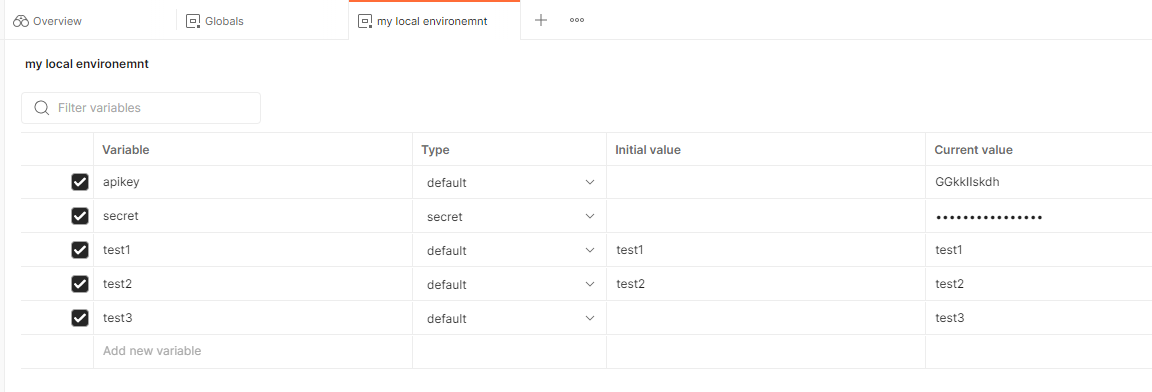
It is just this easy:use variables and do not fill the initial value!

Here the tests: 
First the local postman:

Second the browser postman:


As you can see: the current values are empty inside the cloud for all entries, which have the inital value not filled...
(By the way: the current value is always a copy of the inital value. If you put there something like test11 and test22, only test1 and test2 will show up in the cloud version).